Showing posts with label science. Show all posts

Tuesday, March 31, 2015

Fun Activities to Review the Moon Phases

Well, I hope you are experiencing some warm weather where you are.  The month of March was so incredibly busy for me it just flew by.

This week I decided to go back and do some review activities in Science with my 7th graders.  We had finished up a unit not long ago on the moon and space.  Even after the test, some of my students were still confused on rotation versus revolution, the moon phases, how the moon interacts with the tides, and the different eclipses.

We began by watching Flocabulary's Confessions of a Planet.  They were equally intrigued and mock horrified with the video.  It was a good way to begin the discussion, though.

I first had us complete some foldables from this Space Interactive Notebook file I had bought last year.  We compared and contrasted revolution and rotation.  Then, we labeled the different moon phases and put them in the correct order.


We used these two websites to help us look up the moon phases and review:
http://www.moonconnection.com/moon_phases.phtml
http://www.astronomyknowhow.com/moon-phase.htm

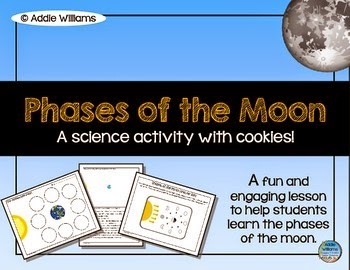
Today we did the activity where you make the moon phases out of Oreos.  Edible labs are always better! I know this is an activity often done with younger students, but I found this great set of lab directions as a freebie from Addie Williams.


It has a great set of procedures and really good questions for them to answer at the end.  It took the activity from just being an activity to truly being more of a lab.


Overall, it was a good week in Science and we got to have some fun reviewing and reteaching. How is your week going?

Wednesday, November 7, 2012

Text Suggestions on Hurricanes and Teachers Helping Teachers

Happy Election Day (or what remains of it).  I have been watching the election results and dozing.  It is so hard to sit still at the end of a day and stay awake (even when it is important).

I just wanted to share a quick post on hurricanes in case you are trying to help your students understand Hurricane Sandy.  I am going to share some text suggestions on hurricanes you could use with your students.

First, I wanted to mention an opportunity if you are looking for a way to help out teachers who have been affected by the hurricane.  By now, you are probably aware of this, but I want to pass it on just in case.  Laurah at the ESOL Odyssey is sponsoring an opportunity for Teachers to Help Teachers.  She has put in a ton of work into organizing this, and it makes me proud to be a teacher when we work together to support one another. There is a form you fill out to choose an item from your store to donate to teachers in need.  You also can blog about it and link up to the linky party to show your support. Many teachers have lost a lot of their materials, and this would would be one way you could help them rebuild.

My students have been studying fast changes to the earth, so we had already been discussing earthquakes, volocanoes, and tsunamis.  We are working on discussing Atmosphere and Air and about to begin our discussion of weather.  As it fits in with the rest of these discussions, I am adding some additional discussion of hurricanes.

Last week we watched this video on Hurricanes from Brainpop. We also watched a Discovery Education video on how hurricanes are formed.  Here is a link to StudyJams and some videos related to weather.  Here is a Magic School Bus episode on Air, which we will watch as part of our discussion of atmosphere and air. 


Now, some text suggestions on Hurricanes:

Looking at several texts on hurricanes is going to give us some opportunity to practice some of the 5th Grade Common Core Reading Informational Standards.

RI 5.5 Compare and contrast the overall structure (e.g., chronology, comparison, cause/effect, problem/solution) of events, ideas, concepts, or information in two or more texts.

RI 5.7 Draw on information from multiple print or digital sources, demonstrating the ability to locate an answer to a question quickly or to solve a problem efficiently.

RI 5.9  Integrate information from several texts on the same topic in order to write or speak about the subject knowledgeably.

We will start by discussing as a group what questions we might have on hurricanes.  Some examples might be:
How are hurricanes formed?
How are they detected?
What can people do to prepare?
What kind of damage to they cause?
How do people rebuild?
What makes hurricane conditions more dangerous?

We will then read one book together and make a 2 column chart for questions and answers. Students will then practice the skill on their own by reading some books independently and putting questions and answers. I may even have some students read about hurricanes and other students read about tornadoes, wildfires, tsunamis, etc. for some variety.

Magic School Bus has a a book called Inside a Hurricane.  My library had multiple copies of the book, so I am debating if I want to do this as a read aloud or have them read it in small groups.  I may use this one as the read aloud. This would be narrative nonfiction as it presents nonfiction information as a fictional story.

Hurricanes: Earth's mightiest storms is an exemplar text for Common Core. It has a lot of historical information on Hurricanes and a lot of pictures. I am actually debating on using this book as the read aloud as well since it is an exemplar text and would be a good book for finding answers to questions. This might be one some students would struggle to read independently as the information is more dense.  By having students read with questions in mind, it gives them an intent for reading.
Do Tornadoes really Twist? Questions and answers about Tornadoes and Hurricanes is a book that is structured as basically questions and answers.
I actually would like my students to read all three books.  We may do one all together and then they can read the other two in stations or groups. We will then compare/contrast the structure of each book.  For each one, I will have them write questions and see if they can find the answers. We will discuss the differences in how the information is presented and if one structure we felt was more effective than another.  This would also be a good opportunity to discuss text features for each text structure.

At the end, they will use the information from all three books to write about what they learned about hurricanes, integrating information from multiple sources.

We may extend this skill by having them the next week each read a book and an article on different types of storms/natural disasters.  I will have them use the same process of writing questions and answers.  They will then write a short presentation/speech on what they learned to present.  I think having them speak on what they learn will be more engaging when there is some variety to the topics.  We will probably just discuss as a group what we learned about Hurricanes.  I may even have them research ways they could try to help efforts for Hurricane Sandy, such as donating to the Red Cross or have them see if there are places to help/donate to kids that have been affected. How are you discussing hurricanes in your classroom? How are you using the Common Core Informational Standards?

Thursday, October 18, 2012

Nonfiction suggestion on Volcanoes: Will it blow?

In my quest to create a literacy rich classroom, I am trying to incorporate more non-fiction this year.  My students have been reading biographies of Olympians because we are finishing up our unit on the Olympics.

In Science, this week and next we are talking about slow and rapid changes to the Earth.  I found this fabulous book at the library called Will it blow? by Elizabeth Rusch.

I am reading it aloud to my students this week.  They are loving it!  How often do you find nonfiction that has kids on the edge of their seat? It is a nonfiction story that teaches students about Mt. St. Helens and volcanoes.  The story is presented as a mystery where the readers have to become detectives to learn how to determine signs of a volcanic eruption. The voice in the story is so fun, and the pictures are very engaging.  It also includes science experiments in the book.  The introduction of the book discusses when Mt. St. Helens erupted in the 1980's and presents what all the volcano did when it erupted.  It presents the description of the eruption like a list of crimes.  Therefore, I had my students make Wanted posters for Mt. St. Helens, listing her crimes.  They loved this task.  They even made me read her list of crimes twice.  Tomorrow, I will share pictures of our Wanted posters.  I am thinking about creating activities for this book for my store or to share.  The vocabulary is also really great.  Would anyone be interested in activities for this book?

What are your favorite activities to discuss slow and rapid changes to the earth?

I have had a couple people "boo" me.  I will be back to share my plans for Halloween in my classroom.  Based on everyone's suggestions, I picked up several Halloween books I want to start reading next week.  I also am finishing up some Halloween writing prompts to use. I really want to find some great Halloween/Fall activities for Math. I have to figure out how to fit in as well spend some time on Election stuff.  Maybe some Halloween and Election activities both everyday?

Wednesday, September 26, 2012

A Failed Experiment and a chance to win custom CRAFT and VOICES bulletin baord headers

When I get stressed, I neglect my efforts to express gratitude.  Shame on me.  Today was better than yesterday.  I feel like I got a lot accomplished, and I actually walked away from work feeling like I am making strides towards feeling organized. So today I am thankful for:

1) This post that that told me about the Photbucket app.  OMG...Uploading photos to my blog from my phone doesn't have to be painful.

2) I got the printer setup in my room. I can now print and copy double sided from my classroom.  We had one printer for the whole building, and it is always in use by teachers and high school students.  It was getting to be a big part of the overwhelming need to get organized.

Uploaded from the Photobucket iPhone App

3) I got some of my signs I made for my classroom put up last night.

4) I have decided I no longer will do experiments for Science...for awhile anyway.  I will send home experiment ideas for students to do at home, and they can bring back the results and photos. We will do other fun interactive projects or stations.

Now, you might want to know why I have decided not to do experiments.  Last week we did all of our Pirate activities, so I thought Ginger's Boat Afloat experiment would be a great ending to the unit.  We made our boats yesterday.  Some of them came out really cute and creative whether they actually worked well or not.

Uploaded from the Photobucket iPhone App
Uploaded from the Photobucket iPhone App Uploaded from the Photobucket iPhone App

I have a small class and a lot of my students are gifted.  This translated to lots of frustration and tears because some people's boats did not hold as many pennies as others and accusations of boat design copying. I never set up the experiment as a competition, but they interpreted it this way. I know I could model experiments for them and just have them watch.  I may decide to do some things this way.  Honestly though, the point of experiments to me seems that it would be fun to do something more hands on.  I feel like we need to work on maturity and handling disappointment appropriately before we revisit the idea of experiments.

So, I would love some suggestions on books or ideas for working on helping students learn appropriate times to express tears and how to handle disappointment. I am thinking I want to get the 7 Habits for Happy Kids book and read it and consider covering it with my students.

Now, some of my successes.  This weekend I really thought a lot about Reading and Writing instruction.  I decided I am in love with Kristin's CRAFT and VOICES boards.  I think they are a fabulous visual way to track strategies we have learned. I did not have enough room in my room to display hers because they are pretty big, so I made my own smaller version to match the paisley in my classroom. I think they turned out super cute.  The CRAFT board is a 3 foot bulletin board so each strategy is about 6 inches across.

Uploaded from the Photobucket iPhone App

The VOICES board I decided to use the front of my supply cabinet because I did not have another big bulletin board.
Uploaded from the Photobucket iPhone App

I did put Kristin's Scientific Method signs on the side of the supply cabinet 2 weeks ago when we started talking about the Scientific Method.
Uploaded from the Photobucket iPhone App

I made new schedule signs to put on my white board to show our schedule every day.  I think it came out very cute.

Uploaded from the Photobucket iPhone App

Finally, I felt my students are both really struggling with Math vocabulary.  Thus, I purchased Ginger's Math Common Core word wall cards.  I purchased 4th and 5th grade even though I knew there was overlap.  I made the Math Word Wall on the back of my door.  I will put up one strand at a time.  This is Operations and Algebraic Thinking.

Uploaded from the Photobucket iPhone App

I would like to do a giveaway for custom CRAFT and VOICES board headers.  They can be in colors and a theme of your choice. Enter below and let me know your successes with using CRAFT and VOICES to track your Reading and Writing Strategies.

And yes, the Photobucket app made sharing these pictures ten times faster than usual.

 a Rafflecopter giveaway

Tuesday, September 18, 2012

Science Ideas and Math Workshop Checklist

First, I would like to announce the winner of my Technology Tips giveaway:  Kristin.  


Congratulations!  You are a much deserved winner.  Kristin has been a great inspiration to me for technology, so I am glad Rafflecopter randomly selected her as the winner.

I have spent like the entire night trying to plan out my Science activities.  My brain is beyond tired.  My students will be studying "Life on Earth" this week. I made a little organizer to go with a video we are watching.  In case it might be helpful to you, you can get it here. It is a doc file, so you can change it.
We are also going to read a short article on the layers of the earth and students will label a diagram of the layers. (The diagram is from Science Penguin's Elementary graphic organizers).  We are going to read Magic School Bus: Inside the Earth during our "Listen to Reading" read aloud. 

For their writing journal entry, students will write about what it be like to journey inside the earth or even discuss what they learned about the Earth. I also grabbed several nonfiction books on Earth from the library to have available for students to read during independent reading.  If I get a chance, I will put together a review of some of the books and how I would use them to share.

I also researched ideas for Science activities.  We are going to start out Thematic discussion of the Olympics this week.  I found this great free Science Olympics activity on TpT.  We are going to do one Olympic Scientist activity each time we have science.  I wanted to discuss the different branches of Science and this seemed a fun way to introduce it.  I am essentially linking up the activities with our Science lessons as best as I can. We will also be working on my Scientific Method menu I made last week. 

Next week, we are going to discuss landforms and complete Science Penguins Weekly 5 activities on Landforms as follow ups to this week's lesson.

I have been trying to figure out how to make my Math Workshop work since I have multiple levels of Math.  I want to try the "MATH" acronym management strategy I have seen on many blogs.  It originated, I believe, with Clutter-Free Classroom. Instead of a rotation board, or maybe just in addition, I want to try a weekly checklist to help hold my students accountable.  They will have a list of "must do" activities for the week for each rotation (Math Facts, At Seat, Teacher Time, Hands On).  In addition, they will have a list of "may do's." I like the checklist because since I am trying to incorporate more technology, it gives me an easy way to provide my students the websites they can use and when. 
Each day, students will fill out what they did in each rotation and end by summing up what they learned and what they still need help with. We will be doing Math on Mondays, Wednesdays, and Fridays, so I have set up my checklist this way.  You can download it here.  It is a doc file, so you can change it to be what you need.  I am going to create a similar checklist for my version of Reading&Writing Workshop/Daily 5. I ran out of steam tonight.

Tomorrow, I want to review some products for you I am excited to share and recommend some great sites I have found that are helping me get organized.

Friday, September 14, 2012

Freebie Activity menu on the Scientific Method

To follow up my post where I recommended 11 Experiments that Failed, I wanted to share something I created today.  I wanted to make a little menu of activities that my students could complete next week to demonstrate understanding of the Scientific Method.  I thought I would try out Dropbox as well.
Classroom Freebies Manic Monday


I am going to keep looking for experiment ideas, but next week we will work on our menu and start our lesson on the Oceans.  Any great books on the Oceans and Oceanography?

I have some products I received this week to review for you.   That will be this weekend.  My technology tips giveaway ends tomorrow.

I am going to watch Snowhite and the Huntsman now on "On Demand." Never thought about it before... Is Snowhite spelled Snowhite or Snowwhite? 

Thursday, September 13, 2012

Book Suggestions Given Printer Suggestions Needed

I keep saying I will got to bed early.  It has not happened.  Good thing today though - I got to talk to my mom for over an hour today.  I usually talk to my mom multiple times a day for short bursts about lots of nothing.  I love it.  She makes me laugh and might be the only that wants to know what I ate for lunch or about my dog's allergies or that I'm tired or that my laundry is wrinkled.  I said one time my mom was my best friend, and a student said "Shouldn't your husband be your best friend?" 

I didn't know how to explain.  I love my husband.  We complement each other perfectly and balance each other.  He is my friend and husband.  I believe whole-heartedly God knew what he was doing when he sent me my husband.  I, whose parents have been divorced since I was a baby, did not believe in the institution of marriage and did not want to ever get married.  So, what did I do?  Marry my high-school sweetheart at 19.  We have grown up together and made all of our major life decisions together.  We love doing things together and talking about our mutual interests.  Do I think everyone should get married young? No.  Do I regret it? No.  But, does my husband what to talk for hours about the same trivial things my mom does? No.  He is my husband, but she is probably my best friend. So, anyway.  I enjoyed catching up with my mom.  We both have been super busy with work and super tired.

I am trying really hard to get organized.  This having multiple grades and multiple ages at once takes some getting used to.  I am enjoying my students immensely, but I will feel better when I get the printing/copying/planning/organizing stuff a little more under control.  I am trying to pick out a printer/copier/scanner for my classroom.  I would like to keep the ink or toner cartridges cost under control.  Any suggestions?  I bought one tonight at Staples because the guy said it was the only one that could do double sided copying for when I needed it.  I don't want my classroom printer to be my main source of copying, but I want the option when I need to.   And double sided seems so much less wasteful.

Today, we read 11 Experiments that Failed

It was recommended by Inside this Book and Teaching Mentor Texts.  It was super cute.  My students loved it.  We followed up the book by thinking of our own questions that could be turned into research projects or experiments.  Then, my students thought about a hypothesis and what procedure they would need.  It was a great way to discuss the scientific method.  Any good experiment ideas for beginning of the year?  Science is new to me and my least favorite subject.  However,  I want it to be fun.  I have been reading all blog posts related to science and trying to get ideas.

I have been listening to audio books when I am in the car.  I am loving the Bloody Jack series by L.A. Meyer. 

It is a young adult series about a girl orphan from London who steals away as a shipboy in the British navy.  Some of the content is mature, but it would be perfect for like 7-8 grade.  I am enjoying the history and the characters.  The audio version is fabulous because the reader is doing lots of voices with all of the various European and class levels of accents.  It would be a fabulous middle school read aloud to tie into World or US History.

Don't forget about the technology tips linky and giveaway.  It ends this weekend.

Thursday, August 2, 2012

Books on the Rainforest and Jungle

I am trying to share texts that tie into Social Studies and Science each week.  This week for my Science related texts, I chose books related to the Jungle and Rainforest.  I have had this stack of books from the library for like 3 weeks, so I am glad to finally have time to sit down with them.

On a side note, many of you are familiar with Accelerated Reader.  If you are not, it is a program that many schools participate in where students take computerized tests over different books to test comprehension.  I no longer will be at a school that utilizes AR, but I do like to still use AR Bookfinder.  AR Bookfinder allows me to search a book title to get an idea of the book level of a book and the interest level.  These can be helpful tools if you are trying to determine if a book might be the right level for your students.  At the same time,  I do not always agree with the AR book level, but I still find it a useful ballpark.

1) Over in the Jungle by Marianne Berkes
 This book is written in rhyme and describes animals who live in the jungle.  The pictures are very vibrant.  Students of all ages would enjoy this as a read aloud.


2) Rainforests by Nancy Smiler Levinson
 This is an easier nonfiction read on the Rainforest.  This would be a great choice for 1st and 2nd grade readers.
3) Defying Death in the Jungle by Gary Jeffrey
 This is a graphic novel. This book begins with a more nonfiction jungle survival section and then has the graphic novel story. It is an adventure story with some historical context. I would have this book in my room for my students who like graphic novels while we were doing a unit on the Rainforest. 


4) Amazon Boy by Ted Lewin
This is a realtively simple read, but it could lend itself to some interesting discussion.  It is about a boy who lives deep in the Amazon and travels to a market town.  He comments on the things he observes.  His father gives him reasons he is saddened to see changes to the Amazon River.  You could use this book as part of a discussion on responsible use of nature and balancing progress with preservation.

5) Rainforest by Edward Ricciuti
This is a pretty straight forward nonfiction text on the Rainforest.  There are plenty of similar books.  Essentially, if you are studying the rainforest, it would be helpful to go to the library and check out a stack of nonfiction books on the rainforest or jungle for students to explore on their own. You can find these books at the library in the Juvenile Nonfiction section under 577.


6)  A Walk in the Rainforest by Kristin Joy Pratt
 I like that this book begins with a world map and illustrates where in South America the rainforest is.  I like this book a lot.  It is a nonfiction ABC book on the Rainforest.  I believe students of all ages might like this book.

7)  Rain, Rain, Rainforest by Brenda S. Guiberson
This book is very descriptive and would be great to integrate figurative language.  This book has some great examples of onomatopoeia.  I think I would follow this book up by having students write some poetry related to the rainforest.


Wednesday, August 1, 2012

Magical Product Swap: Science Warmups

It's time for the magical product swap organized by the wonderful Jessica Stanford.  I told Jessica I need help with science.  I will be self-contained this year and science is the one subject I have not taught yet.

I was matched with Ari at The Science Penguin.  She also will be self-contained this year and has not taught Reading. Thus, we were perfect to be matched. 


Ari sent me two products: her Scientific Thinking and Measurement Stations and her weekly science warmups.  Here are the links to her TpT store and Teacher's Notebook store.

The weekly science warmups are great.  There are warmups for each of the three main Science disciplines: Physical Science, Earth Science, and Life Science.  There are also warm-ups for scientific thinking skills. I am excited about using these warm-ups because I think they will be great quick thinking activities and an easy assessment.  I do not actually have Science scheduled for me everyday, so I'm not sure if I will use them everyday or we may do more than one day's warmup at a time.

I printed it all out and decided to put it all in a binder.  I have been making binder covers/dividers for every possible topic I might need, so luckily I had already made some for Science.  I did not have any Science resources yet, so these got my Science Resource binder started.


What I decided to do was to organize the materials in my binder using a hole punch and sheet protectors.  I used the sheet protectors as dividers with the covers I had already made for the different areas of Science, and then I placed the hole-punched warmups for that topic behind the sheet protector.

The first sheet protector I put Ari's cover she included for the warmups and behind it I put the table of contents and answer key to the warmups.

Then I included the cover and warmups for Scientific thinking:

Followed by the warmups behind each of the three main science disciplines and their respective divider covers.

Then, for the scientific thinking and measurement stations I chose not to hole-punch these so the whole set went into the sheet protector.  These are colorful and include directions needed for the station.  Ari also does a good job of including a teacher resource page with each of her products which provides tips and an overview.  I thought this was great and very professional.  This is something I would like to start doing with my own products.


 I also went to Ari's store and downloaded a couple of her free activities.  She has a Science interest inventory which would be great for the beginning of the year and an S is for Scientists lesson, which looks great.  I plan on incorporating texts and literature into Science, so I am glad to have an extra lesson to use.

 Thanks to Ari my Science Resources binder has been started!  On a side note, I know I need to announce the winners of my huge giveaway.  I have been crazy busy, so I will announce that tonight via another post.

Pin It button on image hover