Tuesday, December 10, 2013

Common Core Math Websites

I thought I would share some of my favorite Common Core Math websites and how I use them.  I teach math grades 4-6 in one room at the same time, so access to easy differentiated practice is awesome.  My students work on lessons through our curriculum, but I supplement with a lot of websites and paper practice.

IXL

IXL is amazing for practice from pre-K to Algebra.  The students can click on the exact links they need.  It works really well because it tells students what they did wrong, and they can find exactly what they need. I also can send specific links to students via edmodo. The only downside is that I cannot assign links to kids. They just added grammar for grades 2-4 as well.  They are supposed to be adding the grammar for grade 5 in January.

Sumdog

Sumdog is a great website that is common core aligned with math practice up to grades 6.  They can play games, so it makes spiral review fun.  Sometimes my students act like they don't like Sumdog as much anymore, but it seems like it would be more fun as a game.  They have grammar practice as well.

Prodigy

Jen Runde mentioned this website on Facebook last night.  I checked it out.  I couldn't figure it out after like 5 minutes, so I gave up but it seems like it could be a more involved game instead of just small games.

Scootpad


I love Scootpad because for the $5 a month subscription you can assign specific skills to specific students.  I am going to use Scootpad as more of an assessment and IXL as more practice.  I love that Scootpad is one of the few with reading practice by standard as well!

Xtramath

Xtramath is great for math fact practice, and it is free.

BuzzMath


Buzzmath is a website for Common Core practice for grades 6-8.  They have missions and little tutorials.  My grade 6 math class likes this website. It is all led by a little mad scientist.

What are your favorite common core math websites?

Wednesday, December 4, 2013

Christmas Writing Ideas and Figurative Language

So we started our December essays today.  I printed the December Essay Menu on cardstock and taped it to the board. I explained that we are going to start doing one essay per month, but they would have choices. I went over the 20 choices on the menu.  They were pretty excited.  Many asked if they could do more than one essay.  My student who was my most reluctant writer last year asked if he could finish his essay tonight at home. It really is amazing to see what choice can do!

Today they picked a topic and started planning their essays with graphic organizers.  A few started writing. I explained we were going to go through the whole writing process.  The pack on TpT includes lots of handouts for rough drafts and publishing. Most of my students wanted to type their essays, so we are going to type ours. I was excited to see my students excited about essay writing.  Who gets excited about five paragraph essays, right?  I think the choice menu each month is going to work really well. We will spend about an hour on Wednesdays working on it.  The rest of the week they can fit it in as they have time. We actually may even turn our essays and stories into a multimedia presentation when we finish just for some fun.

This month we also are going to talk about figurative language.  We will do some figurative language lessons from Lovin Lit's Reading Notebook and Figurative Language Close Reading Stories.  We will use the close reading stories in reading groups. Of course, we have to do Jen Runde's craftivity for Figurative Language.


Now, this last resource I am super excited about. We will analyze Christmas Carols for Figurative Language.  

A few years ago, I had my students get in groups and rewrite the words to Christmas carols to be about themselves.  They came out so cute! We will type up the new lyrics and frame them in an inexpensive frame as our parent gift this year.

Tuesday, December 3, 2013

Planning for Choice and Time in the Language Arts block for Student Engagement and Ownership

I'll forewarn you - this is a long post but lots of good ideas. Sometimes you just have to work through your thoughts...

This is my second year of working in a blended learning environment.  By utilizing online curriculum and student-teacher interaction, students are able to work at different paces and levels. It adds a whole new level to time and resource management as an elementary teacher.  I have a small-class size, but my students still cover a wide variety of reading levels just like with any class. In the past, I taught at a charter school and we used a Reading/Writing Workshop model with Guided Reading. Over the past two years at a private school with a blended learning model, I have worked more on getting adjusted to the Common Core Standards and figuring out the best way to leverage technology for elementary students.  I have done a lot of whole-group reading instruction based on the Common Core Standards to supplement my student's online lessons. 

I have found fitting in guided reading or small-group reading lessons a lot more difficult as I have also worked through what classroom management looks like when you add in a lot of technology and students working highly independently. I have found while technology is great, it also provides more ways to be off-task.  I have found that some students need a lot of re-directing to stay on task.  When students are used to all students working on the same task at the same time, they sometimes struggle to transition to an environment where everyone may be doing something slightly different.  They worry more about what others are doing then focusing on their own tasks. At the same time, as part of the 21st century learning skills students need to work on communication and collaboration.  I think learning to work in groups is important, but learning to focus and tune out distraction is also an important life-skill.

One of my goals for the rest of this school year is to do more differentiated small-group reading instruction, so finding ways to increase student motivation is important to freeing me up to have time to work for a block of time with specific students on reading skills.  It is also important to help my students balance out working independently, working together, and learning to use one another as a resource.

In the last month, I attended the iNACOL conference and the NAGC conference. At both conferences, I came away re-convicted on how important choice, rigor, and depth are for student engagement.  In the past, I have used a lot of choice menus for student assignments and projects. I have always been intrigued by the idea of doing project based learning for opportunities for depth and rigor.  I also always really enjoy reading blog posts from teachers who use stations or rotation models to differentiate for their math and reading workshop blocks.

I decided for now to work on the choice element of student engagement for my Language Arts block.  Because my students work more independently and may vary in the amount of time they need to spend on a task, a rotation model does not work as well for me. I decided to make a chart to plan out my Language Arts block in 15-20 minute increments.  I then designated times for certain whole-group lessons/activities and small-group reading meeting times. Wednesdays I marked off as Writing Wednesday where we will spend an hour on a more in-depth writing assignment (such as our monthly essay writing I mentioned yesterday).

 The rest of the blocks I left blank where they can work independently or maybe in partners or groups depending on the task.  My students will each get a chart where it lists the tasks at the top they need to complete for the week.  Some weeks it may even be broken into more of a must do and may do list of tasks.  Using the chart each week will give us a sense of consistency, while allowing for flexibility to make changes to time allotments and tasks/activities.

They then will be able to fill in those blank "Independent Work" boxes in the chart for which tasks they want to do when.  I made my chart for the week and a template for each reading group in PowerPoint.  I decided to call them reading meetings instead of reading groups, and I think I will change the names for different themes throughout the year. You can get a copy of the PowerPoint file here if you would like to make changes for you.

For now, I was playing with naming my groups seasonal names.  Another teacher today said she liked the idea of naming her groups by color and then color coding their handouts by group name.  I really like the idea of using color paper and color-coding the handouts, so I may change the names to my groups.


My hope is that if students have more choice of when they complete certain tasks, this will help them take more ownership to stay on task.  As we have been talking about getting ready for middle school and SMART goals, this also goes along well with taking ownership of setting and meeting goals.  This process will hopefully allow me to focus more on my goal of doing more differentiated small-group instruction.

As they get better at working independently and taking ownership for their time, we can add in more  group-work opportunities for depth.  I am intrigued by Jen Runde's blog posts on Genius Hour and passion projects.  I think this would be a great way to add in some inquiry-based learning. I need to do more research.  It seems like the projects may be more independent, but by encouraging students to do them in groups of 2-3 you could definitely work on communication and collaboration.

How do you allocate time in your Language Arts block? 

Weekly Writing Inspiration and December Essay Writing

I hope you are getting some great shopping in at the TpT Cyber Monday sale. I spent my fair share today, but I got so many great things!

I wanted to share some writing resources I am really excited about right now.  When I first start blogging almost two years ago, I did a weekly series called "Weekly Writing Inspiration." This is something I started in my classroom several years ago. Each week for our journal writing we used inspiration instead of prompts. We had a quote of the week, a poem of the week, and a picture of the week.  We discussed what we observed, the meanings, and how they could inspire our writing.  It really got the kids to think critically and creatively. As creativity and critical thinking are two of the four 21st century skills, they are something I want to continue to emphasize.

Weekly writing inspiration is something I have done in my class every year, but it usually falls off somewhere during the year because I start running out of time to find a quote, poem, and picture each week.  I have always meant to sit down and compile 40 poems, 40 quotes, and 40 pictures. It never happened as many great teaching ideas find themselves.

Well, the other day I found some resources on TpT that helped me fulfill my weekly writing inspiration goal.

Panicked Teacher's Quote of the Week


Panicked Teacher's Idiom of the Week


Picture of the Day (We just may not do it every day).


We started doing one of these each day before Thanksgiving. We discuss the meanings and use the handouts from the packs. Then, each day we use the quote, idiom, or picture to inspire our journal writing. I just will have to pick out a poem then each week. My goal is to get a monthly poetry pack made with poems to analyze. I made one for March last year. Hopefully, I can get one made for December in next couple days. :)

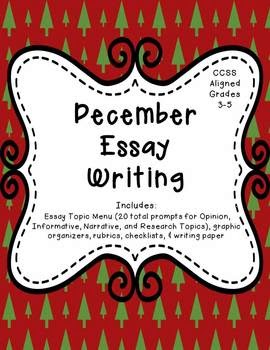
To help my kids get better at multi-paragraph essays, I want to make sure we do at least one essay per month for the rest of the year.  I decided to start making a monthly essay menu with four choices for each of the writing types: informational, opinion, narrative, and research. They will be able to choose, but in 3 essays they need to do an opinion, a narrative, and an informative.  I am excited to share my essay menu for December with my students on Wednesday. 

http://www.teacherspayteachers.com/Product/December-Essay-Writing-Opinion-Informative-and-Narrative-Prompts-1004315

What are your favorite resources for writing and the Common Core?

Saturday, November 30, 2013

Common Core Language Arts Resources on Teachers Pay Teachers and a Sale

Well, I was really excited to have this whole week off, so I could get lots of stuff done along with the resting and being Thankful. I started off my break with a cold, and essentially worked hard this week at taking naps. I am thankful for the rest.

One of my goals this week was to really re-evaluate my Language Arts block. I have found a lot of great resources lately, and I have been struggling to figure out how to fit it all in. It just all seems important! I definitely still need to rework my scope and sequence for the year to really plan out week by week the Grammar lessons and reading skills for read alouds. One of the hardest parts to me of planning for the Language Arts block is planning the schedule and how much time to allocate to different tasks. On Tuesday, I am going to share with you how I decided to re-allocate time in my Language Arts block to better allow for student engagement and ownership. Over the next couple days, I am going to share some of my favorite Language Arts resources I have found for Common Core.

As you probably know by now, Monday and Tuesday are the big Teachers Pay Teachers Cyber Monday and Tuesday Sale. You can save up to 28%. I think I have over $100 of items in my cart right now.  A good sale is the perfect opportunity to stock up on all those items you have been wanting. My store will be 20% off.  You use the code CYBER to save more at checkout.


Here are some of my favorite resources for the Common Core Language Arts Standards:

Resources I have Made:

First of all, I organize all of my Language Arts resources for Common Core by standard. I put all the resources I have made or purchased behind each standard.  It makes it so much easier when planning to have everything in one place. These are my Grade 5 Binder covers and dividers.

http://www.teacherspayteachers.com/Product/Grade-5-English-Binder-Covers-and-Dividers-for-the-Common-Core-Standards-941172

I use my Grade 5 Common Core Reading Literature graphic organizers for whole-group lessons and also independent activities.  They also work well for Guided Reading.


These are my Writing Graphic organizers, checklists, and rubrics for multi-paragraph writing:


These are my Writing Graphic Organizers, checklists, and rubrics for writing one paragraph:


These are my 25 posters for Theme. We use the list of themes and messages as reference when discussing stories. It helps to scaffold instruction as students work to identify theme.


This 2014 Writing Calendar makes a great monthly writing practice for the year, but it also can be turned into a calendar as a gift for parents.  We made these last year, and they came out super cute. I just updated the file to include the calendars for 2014.


Resources I have Purchased and Use Often:

Lately, I have really been convicted of how much kids need spiral review in Language Arts as much as Math. They need to continually practice reading skills, writing skills, grammar skills, Figurative Language, typing, cursive, etc. Thus, I am trying to build time in my Language Arts blocks to weekly review all of these skills.
  • Panicked Teachers' Language Weekly Skills Challenge:  We will use these on Fridays.  These will be a great way to review figurative language. We are going to be working on Figurative Language in December, so these will be a great way to review the rest of the year.


  • Ashleigh's Spiral Language Review: For now, we are focusing on the 4th grade skills before covering the 5th grade Language skills.


What are your favorite Common Core TpT Language Arts resources?

Tuesday, November 19, 2013

Thankgiving take-home project idea for a real world application assessment

I can't believe my first semester of my PhD is almost over. It is almost over, but there is still so much to do. Tonight I just have a quick post.  I want to share a Thanksgiving Break take-home project idea.

I have been thinking a lot lately about wanting to give my students more authentic formative assessments with real-world application.  Last week my students were learning about speed in Science.  Our curriculum wanted them to understand the formula for speed being a relationship between time and distance.  I could have found some problems online and printed them out to practice the calculations.  I decided though I wanted to give them something that might have personal meaning to them.  I told them the assignment was to plan a day trip their family could take here in Texas. They had to pick a city here in Texas that they could drive there and back in a day. We then got on Google Maps and they plotted directions from their house to the city. Even though Google Maps gave them an estimated time to get to their destination, I had them compute the time using the formula for speed. 

For students who picked locations with an hour, they just used an average speed of 40 miles per hour to compute the time to reach the destination. For students who chose a city further away they assumed a highway speed of 60 miles per hour.  We talked about how choosing a lower estimate allows some room for traffic and slow downs. It gave them a chance to practice computing the relationship between speed, distance, and time, but they also thought about what it would be like to plan for that in real life. Students who wanted extra credit then planned out what they would do on their day trip while visiting.

For my students in Math grades 5 and 6, I wanted to give them a take-home project for Thanksgiving that would allow them to think about real-world math applications.  Many of my students are studying fractions, so I thought that Thanksgiving recipes was the perfect at home real world application. Before giving the project, we did a Math warm-up today answering some questions about a recipe. I got the sheet from this Thanksgiving Math pack from the Lesson Lady.  I am using her math sheets as warm-ups all week. She has a variety of skills covered, so it has turned out to be an easy way to get some themed math practice in when I don't have much time this week for more elaborate games and task card activities.


I typed up the directions for the project today and handed it out to my students.  I gave it as extra credit.  They are going to choose a Thanksgiving recipe.  They then have to transform the recipe for a different amount of servings (i.e. double recipe, triple the reciple, or cut it in half).  I told them to really think about their family's needs on Thanksgiving.  They then have to compute the new amounts for the ingredients based on the new serving amounts. The final part is to make the recipe.  They will either video themselves making the recipe or take pictures of themselves making the recipe and type up the directions to the recipe to go with their picture. You could easily turn this into a Math and Language Arts project.  I just assigned it for Math.  Many of my students seemed excited about it, so we will see how many choose to do it. You can get a copy of the directions I handed out here.  They are just simple directions in a Word document, but you can edit them as you need.


What are some ways you try to incorporate authentic assessments with real-world applications?

Wednesday, November 13, 2013

Entrepreneurship Simulation Game for a Lemonade Stand

Did you know that November 18-24 is Global Entrepreneurship week?  You can read more at this link about Global Entrepreneurship Week.

Go Venture is a company that has online games and simulations. They have a free lemonade stand simulation going on starting today through Nov. 24th. Students and adults can play the simulation to create a lemonade stand.  They start out by creating a logo and naming their business. Then they choose the price of their lemonade, the recipe, and purchase their ingredients.  As they go through the simulation, their profits depend on things like the weather, their cost, and whether or not excess inventory spoils. It is a great way to get kids to think about economics and what really goes into supply and demand.  Go to this link to start playing the game. You can click here to register your school in the competition.


You could follow up the simulation by having the kids create actual logos or business cards for their lemonade stand.  They could write up a proposal for a class business. We use hoot loot as a classroom economy and have a store at the end of each month where the kids buy things.  I am thinking of letting the kids propose an idea for a class store where they could identify a product, think of inventory, advertising, profits, etc.

To go with doing the Lemonade Stand simulation, we are going to read Patricia Polacco's book The Lemonade Club.  It is a very touching story about how a class pitches in to help a fellow student who has cancer. The whole idea of the book focuses on the idea of making lemonade out of lemons.  Since we are discussing being thankful in the month of November, I think is a great tie in to the simulation game as well as the ideas of being positive and thankful.


How do you teach your students about entrepreneurship and economics?

Pin It button on image hover