Thrilled with Science Thursday:

This is a few hours belated because I fell asleep at 8pm and woke up at 1am. (I think my favorite time of day and night is 12am to 3am after a nap. I always feel my most inspired after a nap. As a kid, this was when I would clean my room on the weekends. I love night time.).
The text I would like to share with you is
Messages from Mars by Loreen Leedy and Andrew Schuerger. I found this book at the library. It is a super cute book that takes place in the year 2106 with a crew that is going to Mars. Your students can learn about Space and the planets from a crew in the future reflecting back on what it would have been like to live a hundred years in the past - now. This is what I would consider literary nonfiction. The AR level is 4.3. I think you could use it even with a 1st or 2nd grade class though. This would be a great story to infer what it would be like to live 100 years in the future or even think about 100 years in the past. This is a great addition to any space unit. What about even making a class time capsule as a fun extension activity?
Fiction and Freebie Friday

I did not get to participate in Fiction Friday last week, so I have been looking forward to this all week. I love using mysteries with students. They are engaging stories that offer lots of room for analysis and inferencing.
One of my very first
posts I reviewed the books
Chasing Vermeer and
The Wright 3 by Blue Balliett. Both are great mysteries with interesting characters, but fairly simple stories to follow. You could read these with a grade 3 class and above.
My absolute favorite children's mystery is
The Westing Game by Ellen Raskin. The AR level is 5.3.
It's a murder mystery (where you find out no one actually died), but there are around 13 characters and lots of plot lines to keep straight. This is the best book for inferencing, character traits, and probably every reading skill under the sun. With all the characters, it is a complicated read. I would recommend it for probably grades 5-7. My favorite activity for this is to have the students make detective journals. They have a page for each character, where they illustrate a picture of the character and record clues about why that character might be the murderer. End the unit by playing Clue. We also usually make Wanted Posters somewhere mid-unit where they predict who the murderer is and why.
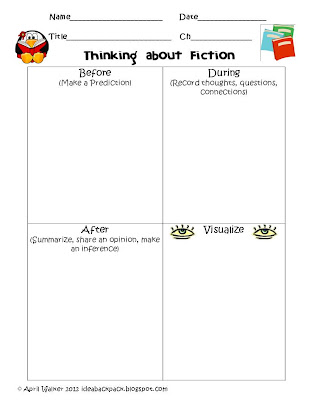
Here is my freebie for you. I love using note-taking with my students. I created a four box method of note-taking to use with Fiction. The first 3 boxes are for Before, During, and After Reading and the fourth box is for visualizing. In the first box, we make a prediction before reading. In the second box, students record questions, connections, thoughts - whatever skill you are focusing on. In the third box, they would write a summary, answer a question, or record an opinion depending on our skill focus. The fourth box students drew what they visualized while they were reading. The first few times I introduce it I give the students the ready-made handout. Once they get the hang of it, they drew the boxes in their journals. For students who need accomodations you can keep the handout. It really is a very easy and effective method for practicing multiple reading skills on a daily basis. Use it for whole group, small groups, and independent reading. It gives you a consistent way to teach students to monitor their comprehension, but also allows for flexibility. Sometimes we even used the same form for a couple days if time was limited.
My note-taking organizer for nonfiction was my own spin off of the Cornell method. They wrote main ideas on the right, vocabulary and questions on the left, and a summary at the bottom. You could use this with Science, History, or even Reading. Same thing after awhile students can draw it themselves.
I also usually either drew a big one on an anchor chart or a small one that I displayed with the document camera.
Happy Friday! Going back to bed now.